

I Would Win Survivor
If Survivor Were a Completely Different Show

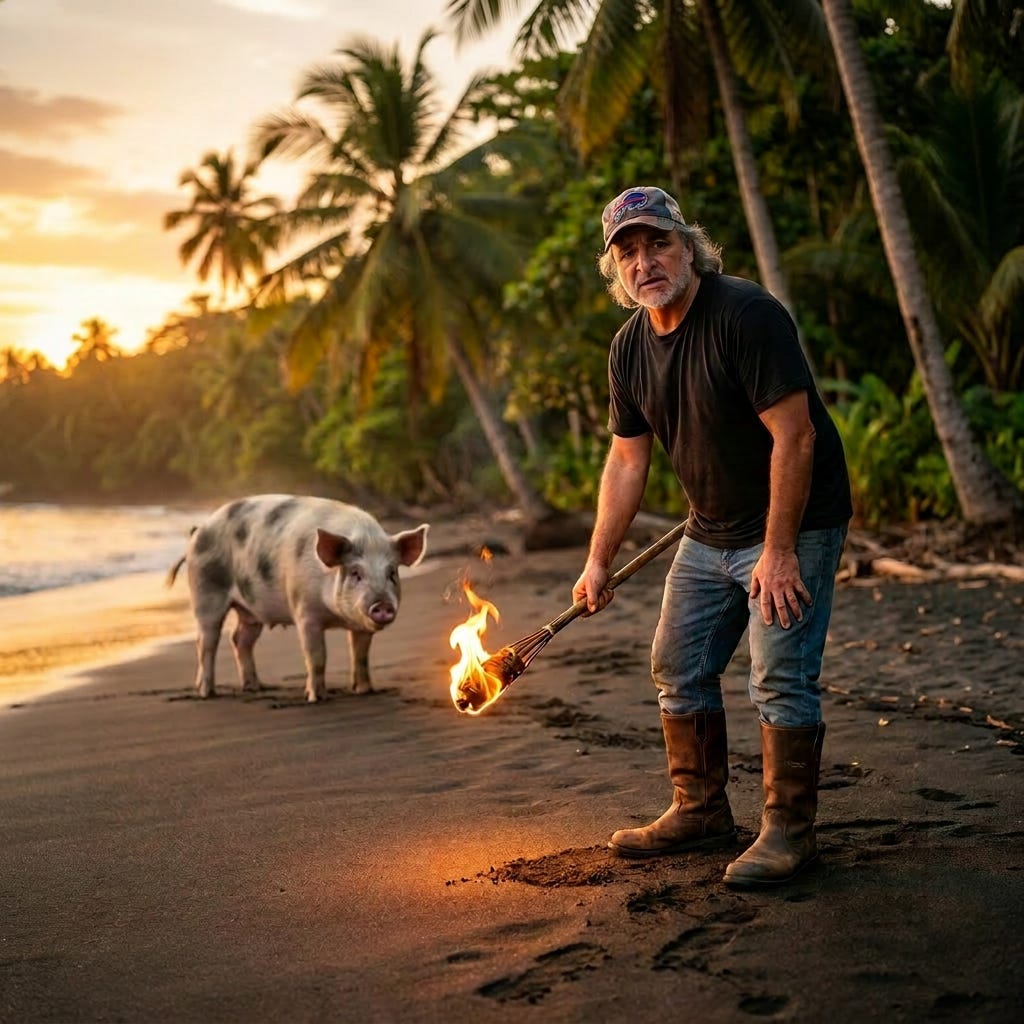
There is something you should know about me before I offer my thoughts on Survivor and what I would do with the prize money: I have credentials.
Not play-the-game credentials. Not sleep-on-a-beach-while-starving credentials. What I have is the deeper, more refined expertise of a man who spent a significant portion of his professional life writing thirty-second promotional spots for Survivor re-runs on Versus.
Versus, if you are keeping score, was a cable sports network that became NBC Sports Network in 2012, which then became a subdirectory on Peacock in 2022. My legacy, in other words, is a streaming tab that no one clicks. I wrote television promos for a channel that dissolved twice. I am not saying this diminishes my authority. I am saying it contextualizes it.
But I watched every one of those reruns on my television, in a New York apartment, alone, in the specific cold loneliness of a man who has contractually agreed to have opinions about content he is now required to actually watch. I have opinions. I earned them the hard way, which is to say: indoors, in socks, with delivery food.
The Part Where Real Winners Spent Their Money Responsibly
Season 50 of Survivor wraps up tonight. The winner walks away with two million dollars, because MrBeast showed up mid-season and doubled the pot, as one does when one is a YouTube billionaire with a spontaneity budget. CNN has been running a lovely feature today on how past winners actually spent their winnings, and the answers are, without exception, more wholesome than I would have guessed.
One guy started a charity for HIV prevention through soccer after winning in Africa. Another donated his entire million to veterans. A third spent ten grand getting his dog a new hip, which he described as the best money he ever spent, and I am not going to argue with that because I have animals and I understand the economy of livestock guilt.
The Season 50 winner, before taxes, will have $2 million. After taxes (and one previous winner reported paying roughly four hundred thousand on his single million), the math gets grim fast. You win two million on national television, and somewhere between eight hundred thousand and one point two million of it is yours, depending on your accountant and how aggressively the Commonwealth of Virginia decides to participate.
The remaining sum is when the decisions get made.
The Part Where I Explain Why I Cannot Actually Play Survivor
Let me be honest with you about the physical dimension of this.
I turned sixty in April. Regular readers know the farm: the 150-pound pig, the blind dog, the chihuahua with the dental degree, Professor Archibald Pickles doing whatever it is a five-pound Scandinavian Lintbøøl does at two in the morning. For new readers: yes, all of that is real, and no, I am not elaborating right now because we are talking about Survivor.
The current season runs twenty-six days. I would be physically fine for roughly the first afternoon. By day two I would be concerned about the fence line. By day three, Karie would have texted that Trouble is giving her the look she gives me when the slop situation is not to her satisfaction, and I would be mentally absent from the game at that point regardless of what tribal council was doing.
The challenges also present an issue. Recent seasons have included things like swimming between large rocks in open water, balancing on narrow platforms for hours, and hauling heavy objects across beaches in direct sun. I grew up in Buffalo. I have shoveled enough things. My body and I have an agreement about physical exertion, and it is denominated in bourbon.
There is also the social game. I understand the social game. I have read about the social game. The problem is that my natural communication style, which people have charitably described as “a lot” and which I prefer to think of as “efficient deployment of personality,” tends to be the kind of thing that gets you voted out of things. I have been voted out of book clubs. I am not in a position to compete with people who have been practicing strategic likeability since their twenties.
And frankly, the island does not have the things that make my daily survival interesting. No one out there is making Karie a pasta dish that is, in retrospect, aggressively over-salted and then waiting to see if she says anything. Nobody is pouring a reasonable amount of whiskey and then reconsidering what “reasonable” means. There are no neighbors flying down a two-lane road at sixty miles an hour like they have somewhere to be in a county where there is, objectively, nowhere to be. That is the texture of my existence. That is what I am surviving. A beach in Fiji with no responsibilities is not survival. That is a hotel that ran out of furniture.
The Part Where I Describe My Version of the Show
What I am pitching, to any producers reading this, is Survivor: Keswick. Twenty-six days. Central Virginia. Nobody has to swim anywhere.
Here is what I notice about the current cast of every reality competition show: they have prepared. These are people who grew up watching previous seasons, taking notes, building spreadsheets, practicing fire-making in their apartments, rehearsing jury speeches in the mirror. They have read books about game theory. Some of them, and I say this with genuine respect and mild alarm, have coaches. They arrive on the island having pre-analyzed the social dynamics of twenty-three strangers they have not yet met.
This is all very impressive, and I mean that sincerely. I just want to ask one question.
Has any of them ever had to explain to a 150-pound pig that breakfast is in fact coming and that the expression she is making is not necessary and that this behavior is not productive for either party? Has any of them handled a fence situation at five-thirty in the morning in January while also mentally reconstructing whether the septic field pump is making a new sound or the same sound it has been making since they discovered, eight years into owning the property, that the pump was already thirty years old when they arrived? Have they negotiated, in real time, with a five-pound animal who has decided that the concept of nighttime no longer applies to him?
This is what survival looks like. Not the show. The show has a medical team and a craft services table fifty yards off camera. Real survival is rural infrastructure and livestock with opinions and a Lintbøøl who treats your sleep schedule as a suggestion.
Survivor: Keswick is simply the show with the pretense removed. Immunity challenge: explain to a county inspector why your fence variance is actually compliant and has always been compliant. Reward challenge: thirty uninterrupted minutes on the porch. Tribal council: conducted around the fire pit. Jeff Probst is welcome but he has to bring something because it is genuinely rude to show up empty-handed and I am not doing this for free.
The jury votes. The jury is animals. The outcome is, in hindsight, completely predictable.
I win. This is my show.
The Part Where I Explain What I Would Do With the Money
Now we are at the actual question.
After taxes, let us say I have one point one million dollars. Here is the allocation, honestly rendered.
Karie gets the generator upgrade she has been asking about for two years. This is not generosity. This is structural debt repayment. I have been nodding at the generator conversation for long enough that funding it at the first available opportunity is the correct legal and marital move.
Trouble gets a second trough. If you have never been given a look by a 150-pound pig who feels that her feeding infrastructure does not adequately reflect her importance to this household, I cannot explain to you why this is a priority. If you have, you already understand, and also I am sorry, and also we should talk.
A meaningful amount goes into pressing vinyl for the Popster Monster and the Payday Fajitas album, which I am currently recording and which will be described in the press materials as “a debut record of confrontational energy and questionable decisions from a man in his sixties who remembers being angry and has decided to be angry again, louder, with better equipment.” This is an investment. I am choosing to believe this is an investment. My accountant is choosing to believe I will not bring this up at tax time.
The rest goes into savings, which is the responsible thing to say and which I offer with full awareness that the hat-business guy from Season 12 also had a plan, executed it, and was fifty thousand dollars in debt five years later. He started a hat company. With Survivor money. I want you to sit with that.
The Part Where I Get Philosophical and Then Don’t
One winner in the CNN piece said that having a million dollars does not improve your life, it just changes it. “Whatever problems you’re gonna find yourself in,” he said, “you’ll find them with or without that money.”
He said this from a position of having won Survivor, starved on a beach for twenty-six days, and presumably done some significant reflection. I respect the journey. I understand the wisdom. The man has earned the right to say something that sounds like a fortune cookie if the fortune cookie had been through some things.
But here is what I want to say back, and I say it with warmth:
Easy for you to establish, my friend. Your blind dog is presumably not regularly walking into the same chair as if the chair is a new development. You did not spend a non-trivial portion of your forties writing promotional spots for a cable network that no longer exists, for a streaming service that also no longer exists, in service of a show whose fiftieth season is apparently tonight.
My problems are specific. My problems have names. My problems have feeding schedules and opinions about the feeding schedules and opinions about the opinions, and none of that changes with a check.
But a man with a paid-off generator, a second trough, and a punk album pressed on vinyl is a man who faces his specific, named, opinionated problems from a position of quiet dignity.
And honestly? That is all any of us can really ask for.
That, and for Jeff Probst to bring something to eat. Something with meat in it. Not a “protein.” Not a “handheld.” Not an artisan situation involving ciabatta and something that has been described as “whipped.” Meat. On a plate. Like a person. Show up to my tribal council with a charcuterie board and I will snuff your torch myself and I will not wait for the vote.
Brian Gerard (Lewandowski) writes books critics call “aggressively adequate” — better than “aggressively terrible” but somehow more concerning, like a smoke detector that only goes off on Tuesdays.
He once traded a MetroCard for a pitchfork on a subway platform and now uses it exclusively for dramatic pointing. He lives on a farm outside Charlottesville, Virginia with a partner who smiles politely at his life choices, a pig named Trouble McFussbucket who has opinions about the sofa, and a five-pound dog named Professor Archibald Pickles who appears to be held together entirely by anxiety and unearned confidence.
See his Amazon author page and buy his books before he spends the royalties on the pig.
Inheriting absurdism from Vonnegut and Adams and weaponized failure from Moore, he writes about conflicted everymen stumbling through supernatural chaos. He has published “The 10-Items-or-Less Apocalypse,” “Not Bukowski,” and “Slop and Swill from a Festering Mind,” and has two new novels seeking a publisher: “Truth Tastes Like Pennies” (available to paid Substack subscribers June 1) and “Elliot Nessie.”
He remains unconvinced that birds aren’t surveillance drones.